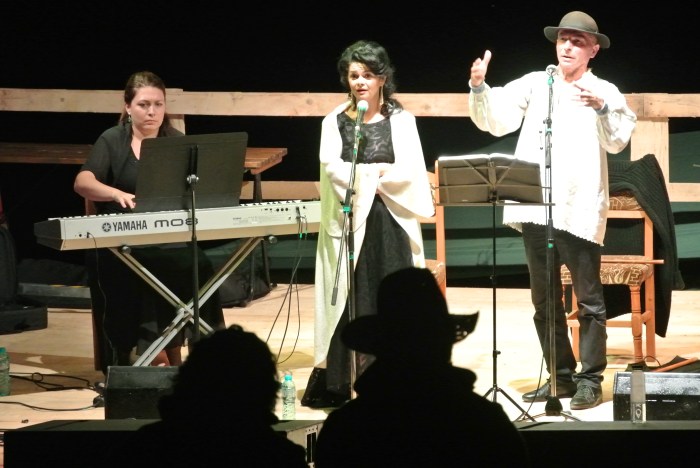
On a hillside above Barsana village in remote Maramures, (a district of northern Romania) Grigore Lese – regarded internationally as the leader of Romanian traditional and pastoral music – created an unrepeatable event of musical theatre last night.
The work, based around music and stories that the local audience clearly knew, involved local singers and instrumentalists, together with classical performers Olga Podobinschi (piano), Mihaela Pletea (soprano) and Maria Chifu (bassoon), and was led by the vocalist and ethno-musicologist Grigore Lese.
Most exciting about the fusion of styles and themes was the way the audience interacted with and joined in singing at times during the evening. The performance was orchestrated and conducted from the stage by Lese who began by introducing the story before leading the audience in a rendition of a well-known folk song. As the audience sang the generator, that was powering lights and microphones on this remote hillside, failed. Without a pause the audience voices swelled in the gathering darkness and Lese left the stage walking among the singing crowd leading the voices from where he could be heard. As the lights and microphones were restored he returned to the stage and the audience continued with him completing the song. The piece then continued – a raised hand from Lese to stage left instructed a vocalist from the choir to guttural expression, or to stage right a lyrical singer joined the performance. At times the pianist (on electric keyboard) sustained a drone to create tension under his vocal explanations, or his singing and traditional pipe playing. At other times the classical performers took over using contemporary and popular music within the framework of this story. Periodically the main theme returned involving the audience in the event, incorporating the entire hillside in a musical rendition of cultural heritage, mixing old and new, traditional and contemporary, young and old.
Under an almost full moon the whole event took on a spiritual quality that was musical and theatrical, unique and site specific. This was a musico-theatrical language that spoke to a very specific community, but even for those like me who had no knowledge of the music, the story or the cultural heritage, the playful interactions of an increasingly inebriated audience with the quiet and masterful leadership from the stage resulted in an engrossing experience.
This was indeed the musical theatre of community.
 Millie Taylor